Saturday, 23 September 2023

SmiZip at the 12th RDKit UGM


I really enjoyed the recent RDKit UGM in Mainz hosted by Paul Czodrowski and his group, and presided over as usual by Greg Landrum. Great talks, and also it was good to catch up with old and new friends. In particular it was great to meet Tim Vandermeersch again, with whom I worked on Open Babel many years ago now. He blew people's minds with a talk about converting SMARTS patterns to highly-efficient C++ at compile-time.
 
My talk was more about shrinking things, specifically SMILES strings. Back in 2001 Roger gave a talk where he described SmiZip, a method to compress SMILES strings. I revisit this, and provide the first public implementation of SmiZip. I also go on to discuss some potential applications including use as a measure of structural complexity:


If SmiZip sounds interesting, check out the info on the GitHub site and then "pip install smizip".

Tuesday, 27 June 2023

Ninth Joint Sheffield Conference on Chemoinformatics

I've just been to the Ninth Joint Sheffield Conference on Chemoinformatics, hosted by Val Gillet. This is a wonderful conference, both socially and scientifically. Thanks to all the team that worked hard behind the scenes (or in front!) to make it happen.

I've been here before - it turns out 5 times:

  • 2007 - 4th
  • 2013 - 6th
  • 2016 - 7th
  • 2019 - 8th
  • 2023 - 9th

...but this is the first time I've given a talk. It was on Handling Large Chemical Spaces in Structure-Based Drug Design, and covered applying generative models to structure-based drug discovery, as well as approaches to tame ultra-large databases like Enamine REAL. We had a few posters also - I'll describe/link these here if they appear online.

From left, Peter Ertl, Max Beckers, Rajarshi Guha, Max Beckers, Chris de Graaf, me.

On the second and third days I took some twitter notes as @ConferenceNoel. If you search Twitter with #shef2023 you will see other tweets from Wendy and others.

I leave you with this picture from the conference dinner at the Mowbray.

Monday, 6 February 2023

Smarts for Dummies Part II

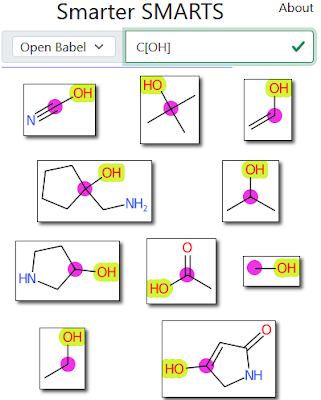
In Part I I described 'Smarter SMARTS', a Python webapp to help you learn to write accurate SMARTS patterns. With Roger's permission, the code for that webapp is now on GitHub. In brief, you enter a SMARTS pattern and you see unique matches (by atomtypes) sorted to show the most unusual first (see Part I for an example).

With the release of the code, I wanted to make a public version for people to try. And so here it is. In contrast to the original, this version doesn't use Python but is entirely in JavaScript (code here).

Implementation Notes

With the move to JavaScript, things slowed down and so to keep the app responsive I turned to web workers. This was my first time using them, but it was surprisingly straightforward, although of course there is a cost in complexity.

I took the opportunity of this webapp to provide support for as many open source toolkits as I could use from JavaScript. Chen Jiang has compiled both Open Babel and Indigo to JavaScript (as part of cheminfo-to-web). There was an additional class I needed for OB, and a tweak required for Indigo, but he sorted it out. Similar work has been done for RDKit by Paolo Tosco but the classes/methods I need are not yet available. OpenChemLib (the library behind DataWarrior) has been available in JavaScript for some time, and I'm hopeful the classes I need will soon become available.

There were some bumps in the Indigo implementation. I found that the equivalent of getValence() did not accurately return the valence, and so I fell back to the much slower approach of summing up the bond orders and adding the implicit Hs. On a similar note, while there is a bond.isInRing() equivalent, there is not for atoms. This is an oversight in the toolkit, as it's a key property - again, I just calculated it myself. And finally Indigo does not support lowercase 'h' in SMARTS - this is documented; you need to use uppercase 'H'.

The depiction is done by John Mayfield's public CDK Depict instance. Thanks John! To highlight the match, I needed to use atom maps to highlight the first atom of the SMARTS match differently than the others. The only problem is that Indigo does not seem to support atom maps; or rather I couldn't get them to work. OB does support them, but that wasn't wrapped. So I used the usual hack for this situation which is to use isotopes instead, write out the SMILES, and then string-edit it into the atom map version. This is all fine until the molecule already contains an isotope, but hey.

The dataset is the 100K smallest molecules in ChEMBL (as of 2018), a number chosen to return results very quickly in the Python version. 100K is not really sufficient to do this problem justice especially once the SMARTS pattern becomes larger. This is why I describe this as a tool to help learn to write SMARTS patterns, rather than a tool to help write them. Not to knock it too much, but if you were to scale up from 100K to 100M and bung in a faster SMARTS search (e.g. Arthor), I think it'd be a more capable tool for someone developing SMARTS patterns.

Monday, 19 September 2022

I am the walrus operator

During my time at NextMove Software I learnt quite a bit about writing efficient C++. I applied some of these learnings to Open Babel during that period, e.g. a 55X improvement in SMILES reading/writing speeds. This was gratifying at the time, but of course the flip side of a 55X improvement is that it was 55X slower before that. Really, code should be written to be 'lean' in the first place.

These days, when I write code, it's in Python. Even though it's slower than C++ (or maybe, because it's slower) I still try to write efficiently. For example, consider the following:

if key in mydict:
    myfunction(mydict[key])
else:
    notfound += 1

Both the first and second lines repeat the same work, looking up the same value in a dictionary. These days, I just can't bring myself to write code that does something twice. Instead, I want to look it up once and use the result twice:

val = mydict.get(key, None)
if val:
    myfunction(val)
else:
    notfound += 1

A downside to this is that it loses a bit of readability. In addition, if 'val' is not used elsewhere then it seems untidy to define it with an apparent broader scope than it needs. (Note that some care is needed with the 'if' statement to avoid problems with values of 'val' that evaluate False. "if val is not None" can help here.)

Enter the walrus operator, :=, which arrived with Python 3.8 (the name comes from the similarity to a pair of eyes with two tusks). This allows you to assign a value to a variable in the middle of an expression; for example in the expression used in an 'if' statement. It was/is quite controversial, and the arguments around it led Guido to step down from the BDFL position he had held since the start of Python.

Here is how it could be used in this case:

if val:=mydict.get(key, None):
    myfunction(val)
else:
    notfound += 1

Is this more readable, or is it confusing? I'm familiar with this idiom from C++, but its overuse and/or abuse can really confuse things. See this stack overflow question for example; imagine seeing that in someone's code and trying to figure out what it's doing. The docs I link to above end with the following request: "Try to limit use of the walrus operator to clean cases that reduce complexity and improve readability." - we'll see how that works out.

My feeling is that the walrus operator is best avoided, or used very sparingly; what do you think?

Sunday, 28 August 2022

Tournament sizes and their effect on selection distribution

If you've ever looked at genetic algorithms, you may have been struck by the counter-intuitive nature of the selection step. In each iteration, you don't take the best results from the previous iteration and combine them for the next iteration; in fact, if you do this, it works very poorly as you get premature convergence to a local minimum as you've gone all exploitation and no exploration. What you need to do is hold yourself back, and select 'goodish' solutions, because goodish can lead to much better in the long run.

One way to do this is with tournament selection. The one parameter is the size of the tournament, T. It works very simply; choose T items at random and keep the best. Remove that item from the pool and repeat this procedure until you have selected the required number of items.

I usually use a value of T=3, but I was curious what exactly this distribution looked like, and the effect of the tournament size. Since I was not able to find an analytical solution (feel free to leave a comment with the details if you do), I wrote a simulation which selects 1000 numbers between 0 and 99 inclusive with different tournament sizes (here I did selection with replacement just to get the distribution of the first selected item). The code also prints out the smallest number where the cumulative sum of the distribution exceeds 50%:

Tournament size of 1: 50% reached at 49
Tournament size of 2: 50% reached at 29
Tournament size of 3: 50% reached at 20
Tournament size of 4: 50% reached at 15
Tournament size of 5: 50% reached at 12
Tournament size of 6: 50% reached at 10
Tournament size of 7: 50% reached at 9
import random
random.seed(1)
import numpy as np
import matplotlib.pyplot as plt

if __name__ == "__main__":
    tour_sizes = [1, 2, 3, 4, 5, 6, 7]
    num_repetitions = 1000
    num_selections = 1000
    for tour_size in tour_sizes:
        averages = [[] for x in range(100)]
        for rep in range(num_repetitions): # repeat to get the mean
            count = [0] * 100
            for i in range(num_selections): # observe the distribution across selections
                # tournament selection of size tour_size
                select = min(random.sample(range(100), tour_size))
                count[select] += 1
            for i in range(100):
                averages[i].append(count[i])
        for i in range(100):
            averages[i] = np.mean(averages[i])
        plt.plot(range(100), averages, label=f'{tour_size}')
        cumsum = 0
        for i in range(100):
            cumsum += averages[i]
            if cumsum >= num_selections / 2:
                print(f"Tournament size of {tour_size}: 50% reached at {i}")
                break
    plt.legend()
    plt.ylabel("Count")
    plt.title("Effect of tournament size on distribution")
    plt.xlim(0, 100)
    plt.ylim(bottom=0)
    plt.show()

Update (2023-06-22): I've guessed the analytical solution as y = 10 . N . f**(N-1) where N is the tournament size and f = 1-(x/100) in the diagram above.

Monday, 15 August 2022

Notes from the 12th International Conference on Chemical Structures

Following on from my earlier blog post, I recently attended the 12th ICCS in Noordwijkerhout, the Netherlands. This was a really great conference, this time organised by Gerard van Westen and colleagues. If you're interested in attending next time, unfortunately you'll have to wait another 3 years...

The conference started with the awarding of the CSA Trust Mike Lynch Award to Dr Greg Landrum, for his work on RDKit and the community around it. As a CSA Trustee, I had the pleasure of presenting this along with fellow trustee Wendy Warr.

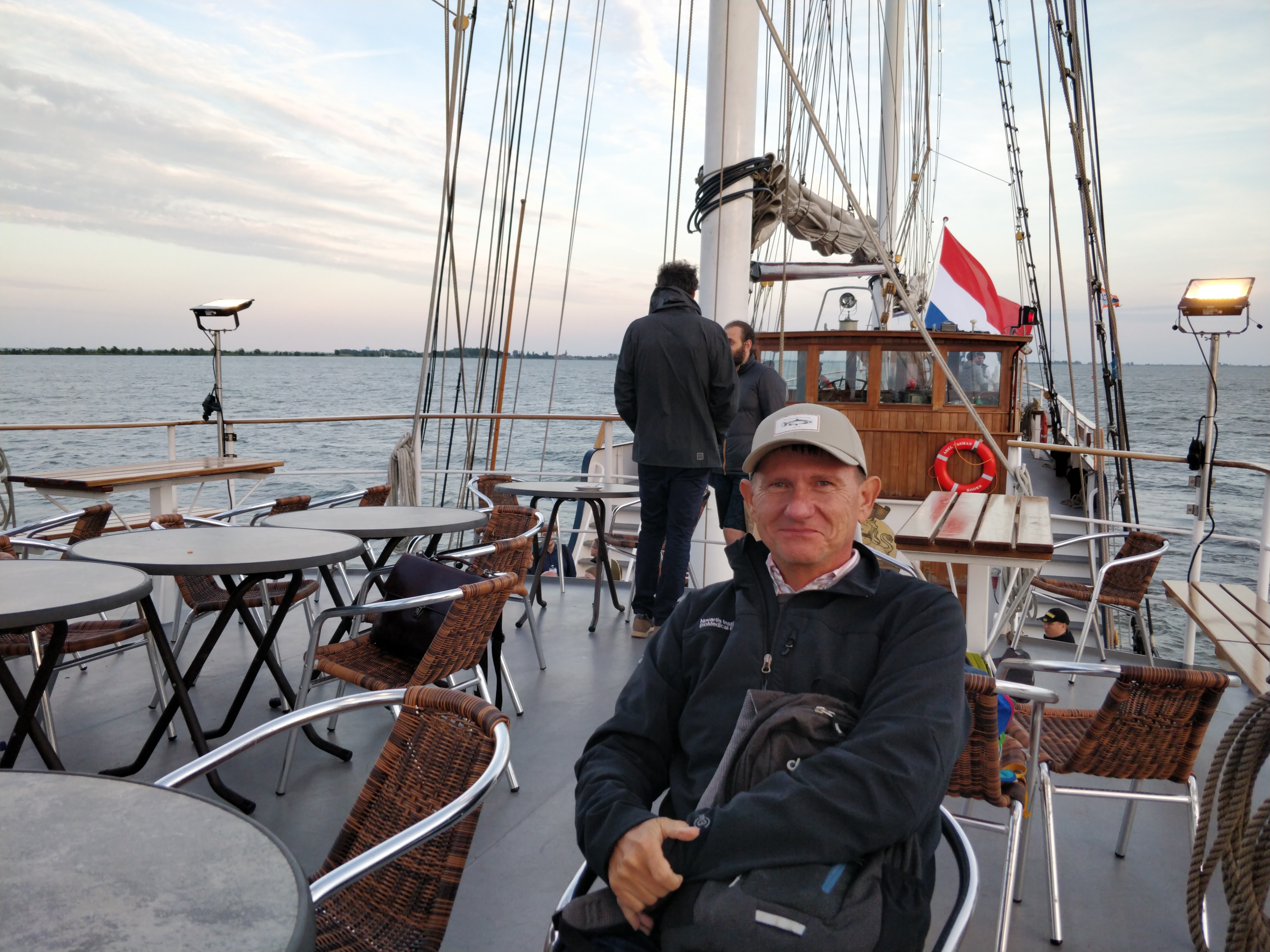
But it wasn't all presenting awards. There was also the cruise on the IJsselmeer to be done, as ably illustrated by Peter Ertl on the right.

And most importantly, the conference itself. Once again I captured my notes as tweets which are available here. Sosei Heptares had three presentations, slides for which are available here:

  • Morgan Thomas (oral presentation): Augmented Hill-Climb improves language-based de novo molecule generation as benchmarked via the open source MolScore platform
  • Dominique Sydow (oral presentation): Integrated Structural Cheminformatics Analysis Tools for Customisable Chemogenomics Driven Kinase and GPCR Drug Design
  • Noel O’Boyle (poster presentation): Application of DeepSMILES to machine-learning of chemical structures

Monday, 25 July 2022

Post-hoc correction of generated representations

The performance of generative models based on SMILES is much improved compared to the early days when only 5-20% of the SMILES generated would be considered valid. In the previous post, an RNN was able to achieve ~96% valid SMILES. Is it possible to increase this still further via post-hoc correction, and if so, is this a good idea?

As a strawman, let's consider a simple approach to ensure that a formerly invalid SMILES becomes valid, which is to trim back the SMILES from the right until only a valid SMILES remains (code at end). Let's look at the results for the failures reported in the previous blog post:

Aromatic system cannot be kekulized
Orig:    Cc1c(NS(=O)(=O)c2cccc3cccnc23)c(=O)n(-c2ccccc2Cl)c1C#N
Fixed!:  C

Unmatched close parenthesis
Orig:    c1cn(-c2ccc3nc(-c4ccc5c(c4)OCO5)nc4ccccc34)[nH]c2=O)cn1
Fixed!:

1 branch has not been closed
Orig:    O=C(NC(C(=O)Nc1cc(Cc2n[nH]c(=O)c3ccccc23)ccc1F)C1CC1
Fixed!:  O=C

2 ring openings have not been closed
Orig:    OCC1CCC2(CC1)CC(Oc1ccccc1)C(C#N)[N+](=O1)[O-]
Fixed!:  OCC

1 ring opening has not been closed
Orig:    CN1C(=O)NC2(CC2(Cl)Br)c1ccccc1
Fixed!:  CN1C(=O)NC2(CC2(Cl)Br)c1ccccc

Aromatic system cannot be kekulized
Orig:    COc1cc(OC(F)F)c(C(=O)NCc2ccn(C)c(=O)c2)c(-c2ccc(N(C)S)cc2)cc1OC
Fixed!:  CO

Aromatic system cannot be kekulized
Orig:    COc1ccc2c(c1)c(Cc1ccc(F)cc1)c(C)[n+]2[O-]
Fixed!:  CO

1 ring opening has not been closed
Orig:    COc1cccc(Oc2ccc3c(c2)C(=O)c2c4c(ccc2CCO)OCO3)c1
Fixed!:  CO

Aromatic system cannot be kekulized
Orig:    O=c1c(Cn2cc(-c3ccccc3)nn2CC2CCCO2)ccn1Cc1ccccc1F
Fixed!:  O

Aromatic system cannot be kekulized
Orig:    Cc1c(Cc2cccc(-c3cc(=O)n(O)c(=O)s3)c2)coc2cc(O)cc(O)c12
Fixed!:  C

Aromatic system cannot be kekulized
Orig:    CC(=O)c1sc2c(c1NC(=O)c1ccc(O)c(OC)c1)c(C)n2C(C)C
Fixed!:  CC(=O)c1sc2c(c1NC(=O)c1ccc(O)c(OC)c1)c(C)n2

1 ring opening has not been closed
Orig:    O=C(Cn1cc([N+](=O)[O-])cn1)N1C2CCC1CC(n1c(=O)c(C(=O)O)nc3cccc1c32)OCOC4
Fixed!:  O=C(Cn1cc([N+](=O)[O-])cn1)N1C2CCC1CC(n1c(=O)c(C(=O)O)nc3cccc1c32)OCOC

Aromatic system cannot be kekulized
Orig:    CC(C)c1cccc(-c2nc3nccc(C(F)(F)F)n3c(=O)[nH]2)c1
Fixed!:  CC

Aromatic system cannot be kekulized
Orig:    CCOc1c(S(=O)(=O)Nc2ccc(F)cc2)c(O)c2ccccc2n1C
Fixed!:  CCOc1c(S(=O)(=O)Nc2ccc(F)cc2)c(O)c2ccccc2n1

Aromatic system cannot be kekulized
Orig:    CC(C)(C)c1ccc(-c2noc(O)n2N)cc1
Fixed!:  CC

1 branch has not been closed
Orig:    Cc1ccc(CN2CCC(C3CC3C(=O)Nc3ccc(S(=O)(=O)N4CCC4)cc32)cc1-n1cnnn1
Fixed!:  C

2 ring openings have not been closed
Orig:    c1ccc(Cn2cnc3c(OCC4CCCN5)nccc32)cc1
Fixed!:

2 ring openings have not been closed
Orig:    CCc1ncc(C(=O)Nc2cc(C3C4CN(Cc5cnn(C)c5C)CCOCC53)c(O)cn2)cn1
Fixed!:  CC

Aromatic system cannot be kekulized
Orig:    C#Cc1ccc2nc3ccc(C(=O)NCCN(C)C)cc3oc2c1
Fixed!:  C#C

Aromatic system cannot be kekulized
Orig:    O=C(c1nc2cc3ccccc3sc2c(=O)[nH]1)N1CCCc2ccccc21
Fixed!:  O=C

Unmatched close parenthesis
Orig:    CC1CN2c3c(nc4c(C(=O)O)nn(-c5cc(F)ccc5F)c4F)n3CC12)OCCO4
Fixed!:  CC

3 ring openings have not been closed
Orig:    COC1CCCc2c1nc1c(c2N)CCc2ccccc2-23
Fixed!:  COC

Uncommon valence or charge state
Orig:    CCOC(=O)C1=C(C)N=C2SC(=C[N+](=O)[O-])NC2=OC1=O
Fixed!:  CCOC(=O)C

Aromatic system cannot be kekulized
Orig:    CN(C)CCn1c(=C2C(=O)Nc3ccc(Br)cc32)c(O)c2ccccc21
Fixed!:  CN(C)CC

Aromatic system cannot be kekulized
Orig:    Oc1ccc(-c2ccc3c(O)c(OC4OCCCO4)c(Cl)c3c2)cc1
Fixed!:  O

Cannot have a bond opening and closing on the same atom
Orig:    Cc1ccc2[nH]c(C(=O)N3CC44C=CC(CC3)c3ccccc34)cc2n1
Fixed!:  C

1 ring opening has not been closed
Orig:    O=C(c1ccccc1)c1cc2c3c(c(OC4OC(CO)C(O)C(O)C4O)c(=O)cc3c(=O)n12)CCCCC3
Fixed!:  O=C(c1ccccc1)c1cc2c3c(c(OC4OC(CO)C(O)C(O)C4O)c(=O)cc3c(=O)n12)CCCCC

Aromatic system cannot be kekulized
Orig:    CCc1cnc(CN(C)CCCn2c(=O)c3cc(F)ccc3n2C)n1
Fixed!:  CC

1 ring opening has not been closed
Orig:    CNC(=O)c1cc2[nH]c(=O)c3c(n2n1)CC1CC3C(C)C(O)CCC12C
Fixed!:  CNC(=O)c1cc2[nH]c(=O)c3c(n2n1)CC1CC3C(C)C(O)CCC1

Aromatic system cannot be kekulized
Orig:    O=[N+]([O-])c1ccc2c(c1)SC(c1nc(Nc3ccccc3[N+](=O)[O-])[nH]c1=O)O2
Fixed!:  O

Aromatic system cannot be kekulized
Orig:    COC1COC(c2c(NC(c3ncccc3Br)c3ccccc3)[nH]n2)C1
Fixed!:  COC

Unmatched close parenthesis
Orig:    O=C(C1CCN(c2cc(N3CCC(n4c(=O)[nH]nc(-c5ccccc5)C4)cc3)OC4)[nH]c2=O)CC1)N1CCCC1
Fixed!:  O=C

Aromatic system cannot be kekulized
Orig:    O=C1COc2c(NC3CCCC3)c(F)cc3c(=O)c(CCc4nc5ccccc5[nH]4)sc(=O)n1c23
Fixed!:  O=C

2 ring openings have not been closed
Orig:    CC(=O)C1=C(O)C=C2Oc3c4c(c(C)c(O)c3C24C(C)CC1=O)OC(C)(C)C(C(=O)N1CCOCC1)C45
Fixed!:  CC(=O)C1=C(O)C=C2Oc3c4c(c(C)c(O)c3C24C(C)CC1=O)OC(C)(C)C(C(=O)N1CCOCC1)C

Unmatched close parenthesis
Orig:    Nc1ncc(-c2ccc(N3CCOC4CCNC4)cc3)cc2)C(=O)[nH]1
Fixed!:  N

1 branch has not been closed
Orig:    CC(O)(C#Cc1ccc2c(c1)C(O)(c1cn(C3CC(O)C(CO)O3)c(=O)[nH]c1=O)CC2(C)C
Fixed!:  CC

1 ring opening has not been closed
Orig:    CNCCCn1nc(COc2ccc3c4c(c(O)c(C)cc3c2=O)C(=O)N2CCCC2)c2c(N)ncnc21
Fixed!:  CNCCC

Aromatic system cannot be kekulized
Orig:    Cc1cc(NC(=O)NC(C)c2ccccc2)n2ccsc2n1
Fixed!:  C

Aromatic system cannot be kekulized
Orig:    COc1ccc2c(c1)CCc1c-2c2c(c3c1[nH]c1ccc(O)c1c3=O)C(=O)CCC2
Fixed!:  CO

Aromatic system cannot be kekulized
Orig:    Cn1ccc(Nc2cccc3ccccc23)c(N)n1
Fixed!:  C

Aromatic system cannot be kekulized
Orig:    CN1C(=O)c2c(n[nH]c2=O)Cc2ccccc21
Fixed!:  CN

2 ring openings have not been closed
Orig:    C=C1CCC2=CC(O)C3Oc4c(O)ccc5c4C34CCN(CC1C2C)C3O5
Fixed!:  C=C

Aromatic system cannot be kekulized
Orig:    O=C(O)c1c2c(c3cc(F)ccc3nc1-c1ccccc1)n(C)c(=O)n2C
Fixed!:  O=C(O)c1c2c(c3cc(F)ccc3nc1-c1ccccc1)n(C)c(=O)n2

As can be seen, the trimming can be rather drastic. But one could imagine more subtle methods. Errors about aromatic systems would disappear if Kekule SMILES were used. If ring openings were found to not be closed, then either close them on the last atom or ignore the opening. Ditto for branches.

If we look at SELFIES, we can see some of these approaches applied. Any characters beyond an invalid valence are ignored ("[C][=O][...]" as "[C][=O]"). If a branch is indicated but the number of atoms is fewer than this or information is missing, then the branch is assumed not to exist ("[C][Branch1][O]" treated as "[C]"). Similarly for rings.

I was curious how often these post-hoc corrections occur for a typical dataset. Given the same RNN trained on SELFIES (v1.0.4), 10K SELFIES were sampled and I calculated the % of times where removing the last symbol left the resultant SMILES unchanged (i.e. where at least the last SELFIES symbol is not being interpreted). This gave 10.5%.

Returning to the SMILES failures above, where the NN cannot learn the syntax, does it makes sense to apply post-hoc corrections to ensure validity? For example, if kekulized SMILES are used, then the errors about aromaticity will go away; if there is no change to the distribution of generated aromatic ring systems then this would be a win. The trimming method above is more problematic: two very similar representations could be interpreted as molecules of very different size (causing a discontinuity in the search/latent space). Indeed, given that all characters after an invalid state are ignored, the DNN could end up being trained on noise. A potentially better approach (although still symptomatic of a failure to adequately learn the syntax) would be to handle an uncommon valence or charge state by resampling from the generative distribution in the first place (the partialsmiles library might be helpful here as it can catch such failures as early as possible).

Code

import partialsmiles as ps

if __name__ == "__main__":
    fname = "Regular_SMILES_1K.smi"

    failures = []
    with open(fname) as inp:
        for line in inp:
            smi = line.rstrip()

            ok = False
            msg = None
            try:
                mol = ps.ParseSmiles(smi, partial=False)
                ok = True
            except ps.SMILESSyntaxError as e:
                msg = e.message
            except ps.ValenceError as e:
                msg = e.message
            except ps.KekulizationFailure as e:
                msg = e.message
            if not ok:
                failures.append( (smi, msg) )

    for smi, msg in failures:
        i = len(smi)
        ok = False
        while not ok and i >= 1:
            try:
                mol = ps.ParseSmiles(smi[:i], partial=False)
                ok = True
            except:
                i -= 1
        # Invariant: Either ok or i == 0

        print(msg)
        print("Orig:   ", smi)
        print("Fixed!: ", smi[:i])
        print()

Credits

This blog post originates in a conversation with Janosch Menke, Michael Blakey and John Mayfield that started at the ICCS. Thanks also to Morgan Thomas for data and feedback. Image via Flickr by epictop10.com (licensed CC-BY 2.0).